
By The Net Reputation Global Team | Read Time: 5 Minutes

There is a sinking feeling every business owner knows: waking up to a notification that someone has trashed your reputation online.

Whether it is a scathing 1-star Google review or a negative news article, the immediate instinct is to scream, “This is a lie! Take it down!”

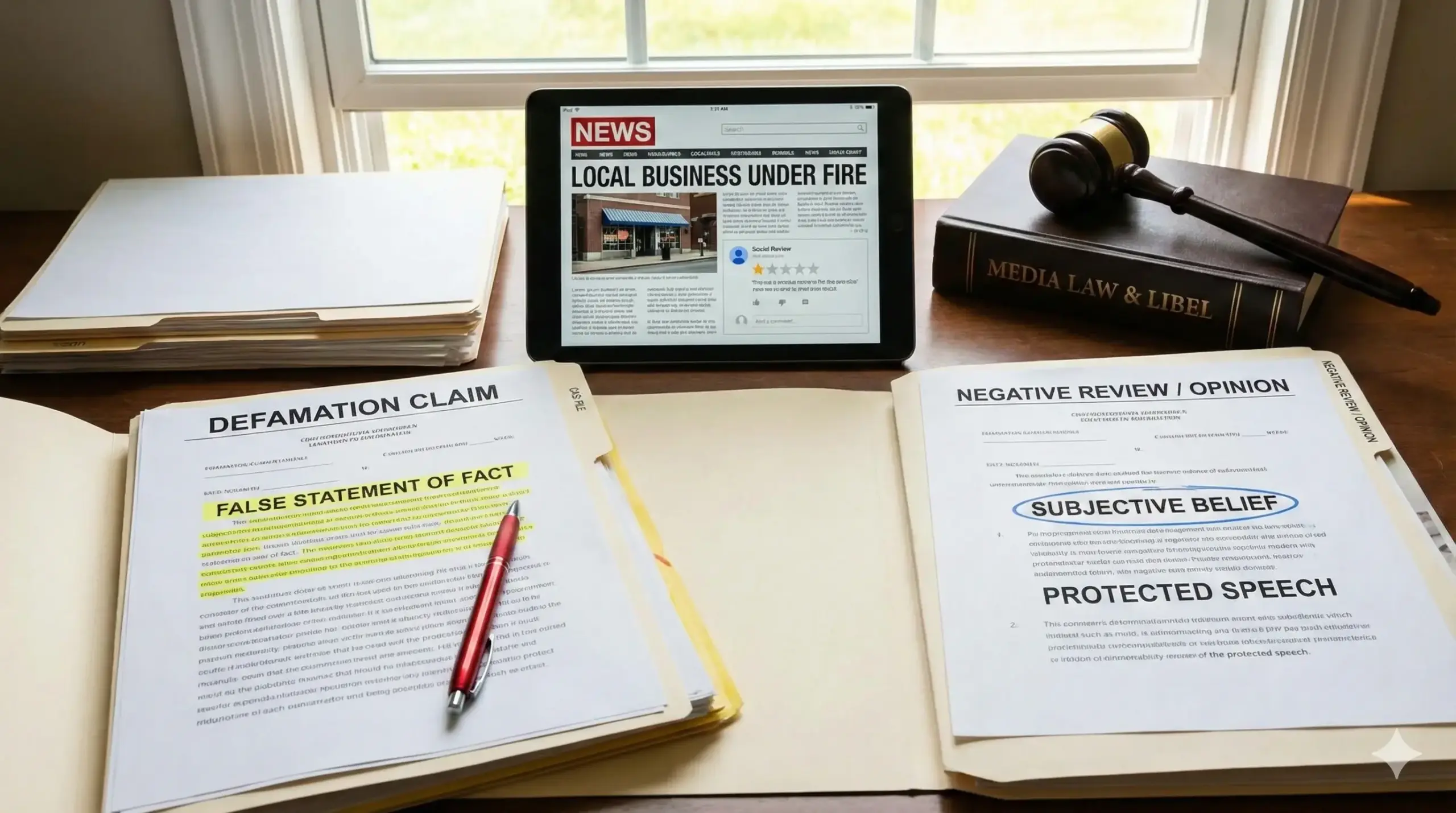
But from Google’s perspective (and the law’s), there is a massive difference between a “lie” and an “opinion.”

At Net Reputation Global (NRG), we review thousands of removal requests. The harsh reality is that 90% of removal requests fail because the victim attacks an opinion rather than proving defamation.

If you want content removed, you must understand the rules of engagement. Here is the 2025 guide to the difference that matters.


The “Golden Rule” of Removal: Fact vs. Feeling

To get content removed—whether via a court order or a Terms of Service (ToS) violation—you generally need to prove the content is demonstrably false.

1. What is an Opinion? (Protected)

An opinion is a subjective feeling. It cannot be proven true or false. In the US and most Western countries, this is protected speech.

  • Example A: “I think this CEO is incompetent.” (Subjective)
  • Example B: “The pizza tasted like cardboard.” (Subjective)
  • Can it be removed? Rarely. Google will not take down a review just because it is unfair or mean.

2. What is Defamation? (Removable)

Defamation (Libel) is a false statement of fact that causes harm. A fact can be proven wrong with evidence.

  • Example A: “The CEO stole money from the pension fund.” (Fact: Did they or didn’t they?)
  • Example B: “This restaurant served us rat meat.” (Fact: This can be tested.)
  • Can it be removed? Yes. If you can prove the statement is factually false, you have grounds for removal.

Expert Insight: Google moderators are not judges. They will not mediate a “he-said, she-said” argument. To win a removal, you must provide undeniable proof (like a health inspection report or court docket) that contradicts the review.


The 3 Categories of Removable Content

You don’t always need a lawsuit to remove content. At NRG, we categorize removable content into three buckets:

Tier 1: Terms of Service (ToS) Violations (Fastest)

Before arguing defamation, check if the content breaks the platform’s rules. This is the fastest route to removal.

  • Conflict of Interest: A review written by a competitor or a former employee.
  • Harassment/Hate Speech: Content using slurs or attacking someone based on race/gender.
  • Doxxing: Reviews that reveal personal phone numbers or addresses.

Tier 2: Defamation (Requires Evidence)

If the content is a polite but lying news article, ToS won’t help. You are now in legal territory.

  • The Strategy: We often use an attorney-backed approach to draft a demand letter to the publisher (not Google). Many blogs or small news sites will remove an article to avoid a costly legal battle, provided you can prove the info is false.

Tier 3: Copyright Infringement (The “Nuclear” Option)

Did the negative article use a photo you took?

  • The DMCA Strategy: Under the Digital Millennium Copyright Act, if you own the copyright to an image used in a negative article, you can force Google to de-index that specific page or force the host to take the image down. This is a technical strategy that requires precision.

Why “DIY” Removal Often Backfires

We see many clients try to handle this themselves, only to make it worse via the Streisand Effect.

  1. Responding Emotionally: A business owner replies to a bad review with insults. Now, the reply goes viral, not the review.
  2. Triggering Updates: If you email a news editor angrily, they may update the old article to say, “Update: CEO threatens to sue us,” which makes the article fresh and ranks it higher on Google.
  3. Incorrect Flagging: If you flag a Google review for the wrong reason (e.g., flagging “Spam” when it’s actually “Conflict of Interest”), Google’s AI will reject it, and it becomes much harder to flag successfully a second time.

Conclusion: Don’t Guess, Strategize.

Your reputation is an asset. Treat it like one. If you are dealing with a vague 1-star review, a polite public response is your best bet. But if you are dealing with false allegations or defamatory articles, you need a surgical removal strategy.

Unsure if your case qualifies for removal? Submit your link to the Net Reputation Global team for a feasibility analysis.

Leave Your Comment:

Your email address will not be published. Required fields are marked *